
New beginnings
Champagne's tentative embrace of regenerative farming

Please join me this Thursday evening at 7PM Paris time, 6 PM London time, 1 PM Eastern time, 10 AM Pacific time, 7 AM (Friday) New Zealand time for another Substack Live. Joel Butler MW will be my guest and we will look at wine pricing and wine production costs and discuss the risks of Champagne pricing itself out of the US market. Looking forward to be seeing you then!
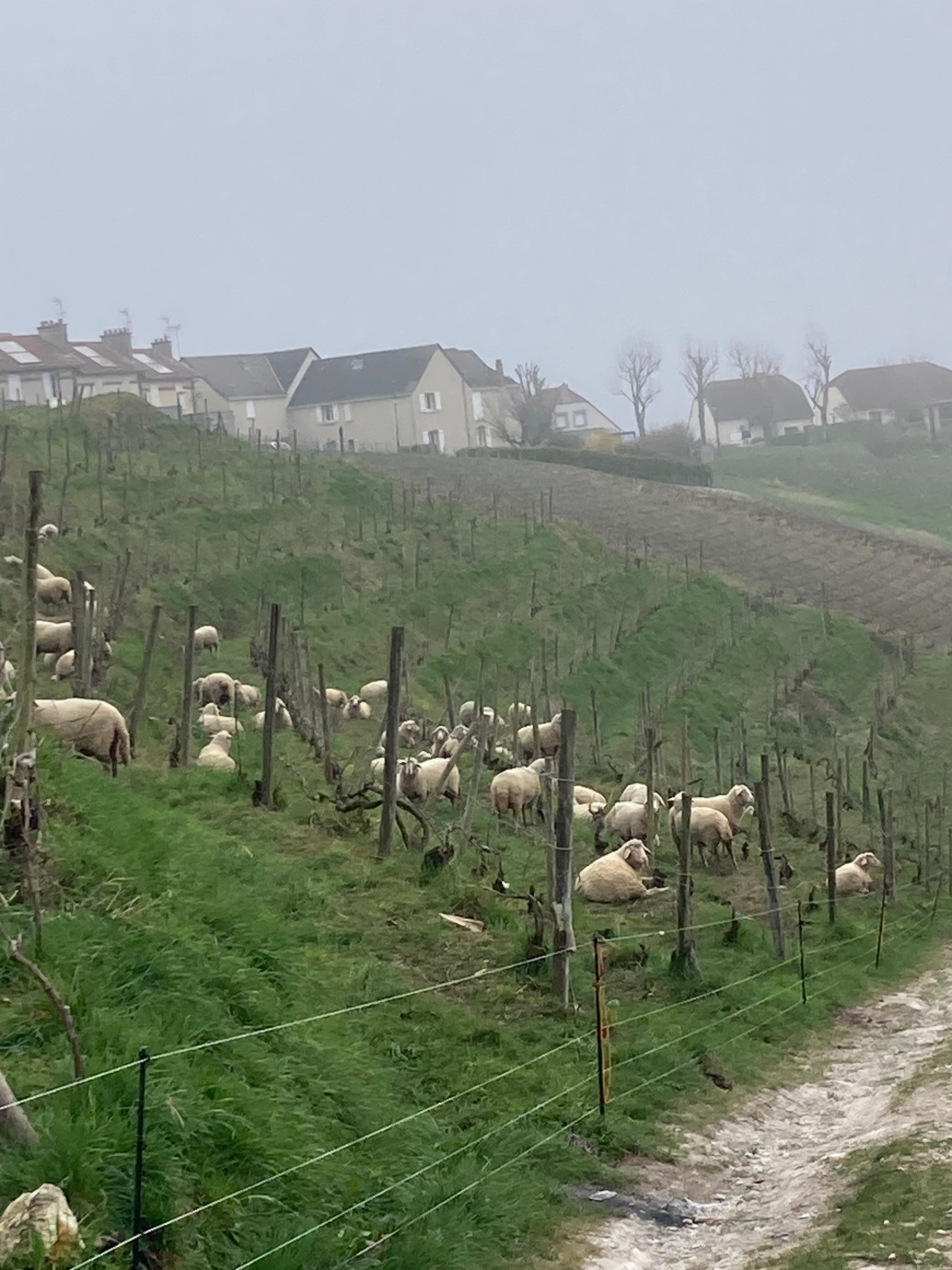
As more Champagne winegrowers are dousing their vines in glyphosate once again – despite the wet and cold February weather - it is important to point out that there is also a rising regenerative viticulture movement.
Regenerative viticulture has been defined by the Wine and Spirits Education Trust (WSET) as “a farming approach that collaborates with nature to restore vineyard soils and biodiversity while reducing dependency on synthetic chemicals. This method can lead to improved plant nutrition, better grape berry quality, and the suppression of pathogens and pests in the vineyard. “
Regenerative practices were originally researched by several big houses once the appellations co-presidents had committed – in 2018 - to eradicate herbicides by 2025. Several large houses like Moët & Chandon, Veuve Clicquot, Krug, Perrier Jouët and Mumm among others began to exchange glyphosate for cover crops, often with the aim to sequestrate soil organic carbon (SOC), thus using the soil as a carbon sink. They were not the first ones in Champagne to engage in exploring different cover crops: pioneers like Bollinger, Roederer, and several growers (Pouillon, Tarlant, Augustin ..) had already paved the way from the beginning of the 21st century. Though these producers often originally engaged in cover cropping as a way to enrich the soil and build up organic matter rather than sequestering carbon.
Today, cover crops have become a regular winter vineyard feature, even if, in a way, they remain anecdotal on appellation level. People are also not that surprised anymore to see animals in the vineyard – for instance both Moët & Chandon and Taittinger have sheep in their Hautvillers vineyards annually, and several growers work with a variety of other animals, going from geese to pigs. And off course, tilling by horse has gained in traction over the last decade as well.
Still a lot of these practices too often remain under the radar, both within the appellation and to outsiders. One of the reasons is undoubtably many Champagne growers’ deep anchored love for herbicides; they are so set on hanging on to them that they are not willing to explore soil enriching practices (other than the yearly dose of fertilizers needed to maintain a healthy yield). In fact, many growers continue to maintain that houses will move back to their previous herbicide usage because ”they are unable to maintain decent yield (e.g. yields above 10 tons/hectare (T/ha)) without them.”
In my opinion these musings are mere wishful thinking by a selection of growers believing that large commercial yields are here to stay (despite proof to the contrary), but it’s important to remember that lies that are repeated enough end up being accepted as general truths. In fact, the other day a local grower repeated the above claim when we were discussing illegal and very early herbicide abuse in a vineyard near his. When I mentioned houses commitment to regenerative practices – the grower in question told me it was just a fad that would blow over soon enough because “that way of farming does not allow to produce them enough bottles”, elaborating that most houses engaged in these practices were “lucky to harvest 5t/ha”. Once again this is based on hearsay (on dit in French) rather than real data, but it shows the reluctance of many a grower to even consider a better way of farming. Ironically, they are all aware of vineyard erosion, but they see this a more as a nuisance rather than a serious issue. I have even had people tell me that regenerative practices and organic farming are to blame for Flavesvence Doree, again based on “common” hearsay.
Yet despite their resistance, both organic viticulture and regenerative practices have expanded significantly in Champagne over the last decade, though initial Bio Grand Est 2025 data suggests that organic farming has taken a little hit with both surfaces
